The conference was an impressive experience due to its sheer size and diversity. With around 20,000 participants, the conference centre often felt overwhelming, and it was easy to lose track of people and the many parallel sessions. Every time slot required choosing between many interesting talks and activities, which made the experience exciting but also intense.
One of the most valuable aspects for me was seeing the enormous breadth of research being conducted in biogeosciences and forest-related topics. I attended sessions ranging from highly detailed laboratory and cellular-scale studies to global applications involving satellite imagery, large-scale mapping, and new methods for processing big datasets using artificial intelligence, machine learning, mathematics, statistics, and computer science. This diversity made me realize how important it is that so many researchers contribute their own small piece to a much larger scientific picture. At the same time, the conference also confirmed for me where my own passion lies: single-tree and forest-stand point clouds, combining ecology with technology. I found myself most engaged with these topics and realized even more clearly that this is the field in which I would like to continue working.
Besides the specialized scientific sessions, I also attended several broader discussions and short courses. One particularly memorable event was a debate on geoengineering and climate change. Interestingly, it did not feel like a true debate because all speakers largely defended their existing positions without moving toward consensus. In a way, this reflected the current state of geoengineering itself: potentially necessary for addressing climate change yet surrounded by concerns about unpredictable and uncontrollable side effects.
Another session focused on the question: “Do we still need journals?” Researchers, editors, and metascientists discussed the role of scientific publishing. I found this discussion very insightful because it highlighted both the importance of journals for maintaining scientific standards and communication, as well as the problems associated with the current publication system, especially the commercialization of publicly funded research.
I also attended a short course about postdoctoral careers. One statement from the course stayed with me: Pursuing a postdoc is not always a rational decision. It often involves insecurity, limited rewards, and considerable personal sacrifice, yet many researchers still choose this path out of passion, curiosity, and hope. I found this perspective both honest and motivating.
Another course addressed science communication and the growing challenge of maintaining public trust in science. The discussions emphasized the fragile relationship between science and politics: science depends on political support and funding, while politics increasingly seeks to shape scientific priorities, often favoring topics with immediate economic benefits. I found these reflections very relevant in the current societal context.
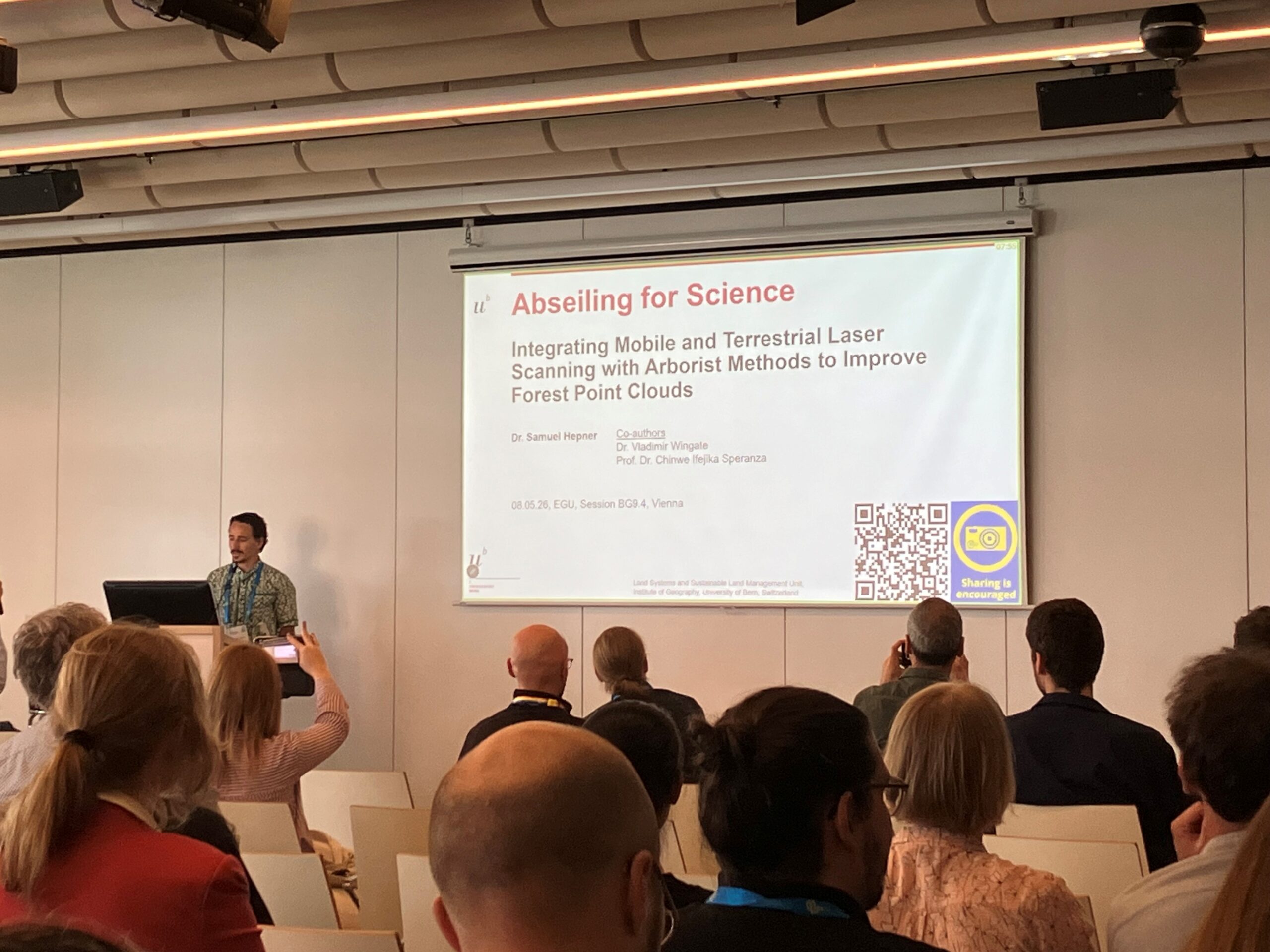
The highlight of the conference for me was presenting my own work, titled “Abseiling for Science: Integrating Mobile and Terrestrial Laser Scanning with Arborist Methods to Improve Point Clouds.” Presenting this project internationally felt especially meaningful because reaching this point had been uncertain for a long time. Together with Dr. Vladimir Wingate, we gradually developed the project over several years through multiple grants that enabled training courses, equipment acquisition, and fieldwork. This final grant enabled us to present the work at an international conference, which felt like an important milestone for both of us. We were happy and proud to see the project reach this stage, especially knowing how much effort and uncertainty had accompanied the process.
The presentation itself went well: I stayed within the time limit, communicated our current work clearly, and received positive and constructive feedback.
The audience asked thoughtful questions, showed genuine interest in the topic, and I had several inspiring conversations afterwards that could potentially lead to future collaborations and new research ideas. Although the EGU conference covers nearly every area of geoscience imaginable, the experience also made me realize the value of smaller and more specialized conferences, particularly within the niche of single-tree and forest-stand research. In this regard, attending the SilviLaser conference in Warsaw in 2027 could be a very interesting opportunity.
Text: Dr. Samuel Hepner