Unpacking Degradation in Forest Patches across West Africa: Integrating Multi-Scalar Remote Sensing and Diverse Knowledge Systems
Chima Iheaturu
Tropical forest change is usually framed around large-scale deforestation, but in long-settled West African agricultural landscapes the dominant processes are fragmentation, chronic disturbance, and gradual structural erosion within small forest patches. In a region where more than eighty percent of the original forest cover has been cleared, remaining forests persist mainly as small patches embedded in local livelihood systems and governance institutions. These patches sustain biodiversity, cultural value, and ecosystem services, yet they are systematically overlooked by satellite monitoring systems designed to detect abrupt canopy loss at medium resolution. As a result, patches can appear stable from space while undergoing substantial internal ecological change.
Drawing on nine field sites across Togo, Benin, Nigeria, and Cameroon, spanning gradients from the sub-humid Guinean savannah to the humid Guineo-Congolian forest, this dissertation combines Landsat time series, UAV LiDAR and multispectral data, and local knowledge to improve how forest patch dynamics are observed and interpreted. It shows that conventional pixel-based validation underrepresents small and irregular patches, that satellite data and local knowledge diverge where degradation occurs beneath intact canopies, and that high-resolution structural data can reveal this hidden erosion. It also develops practical tools, including an object-based sampling method for fragmented landscapes and a sensor-alignment protocol for assessing forest recovery.
The work argues that accurate forest assessment depends not only on higher-resolution data, but also on clearer definitions of what forest change is and whose knowledge counts in reading it.
Keywords: West Africa, Forest patches, Agricultural landscapes, Ecosystem Services, Spatio-temporal dynamics, Multi-scale modelling, Sustainable forest landscapes
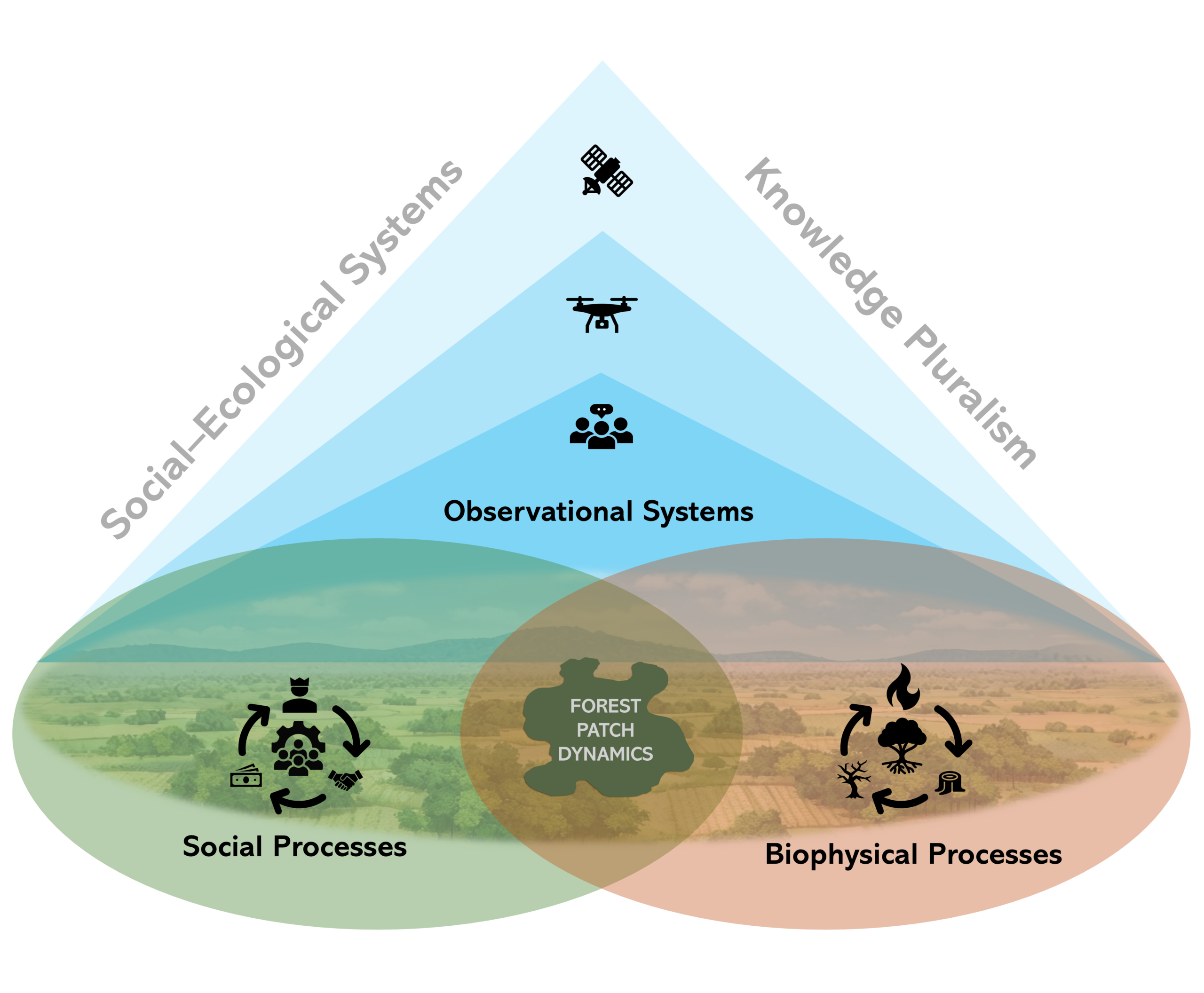
Forest patch dynamics (center) arise from the coupling of biophysical processes (disturbance regimes, regeneration, edge effects), social processes (governance, livelihoods, political-economic drivers), and the observational systems (satellite remote sensing, UAV-based sensing, local knowledge) through which change becomes visible and actionable.